
Homeowners' 10 Minute Hot vs Cold Test to Locate Sulfur Smell in Water
That rotten-egg smell is almost always hydrogen sulfide gas, either from natural groundwater chemistry or sulfur-reducing bacteria living somewhere in your plumbing. Before you buy any treatment equipment, run a simple hot versus cold water test with the softener bypassed and note exactly where the odor shows up. If the smell is new, gets worse, or you’re worried about health risks, skip straight to lab testing for bacteria and basic water chemistry.
TL;DR:
Water testing should include bacteria, nitrate, pH, TDS, iron, manganese, sulfate, and hydrogen sulfide levels to identify the true source and appropriate treatment.
Activated carbon filters are suitable for low hydrogen sulfide concentrations, while aeration handles moderate levels, and oxidizing filters or chlorination are necessary for higher concentrations.
Regular maintenance, such as filter replacement, tank flushing, and softener sanitizing, is essential to prevent recurrence of sulfur odors and avoid pipe corrosion.
Shock chlorination can quickly reduce bacterial odors but may need repeated applications or continuous treatment for persistent cases.
Diagnosing whether the smell originates from the well, water heater, or plumbing system saves money and ensures targeted, effective treatment.
Table of Contents
Diagnosing Sulfur Smell In Water: A Step-By-Step Check
You don’t need a plumber’s toolbox to figure out where a sulfur smell in water is coming from. You need patience and a working faucet, and about ten minutes.
Public health departments recommend the same sequence every time, because it works. Here’s the order to run it in:
Let the house sit unused for a few hours (overnight is ideal), then run the cold water first from a faucet farthest from the water heater. Note the smell intensity right away and after a minute of running.
Run the hot water from the same faucet. If the smell only shows up here, your water heater is the likely source, not your well or municipal supply. Heat drives dissolved hydrogen sulfide out of water and into the air, which is why showers often smell worse than a glass of cold tap water even when the underlying cause is the same.
Bypass the water softener if you have one, then retest cold water. If the odor disappears with the softener bypassed, the resin bed itself has likely become a breeding ground for sulfur bacteria.
Test a second faucet in a different part of the house. If only one fixture smells and others don’t, check that drain and P-trap before blaming your water supply at all.
Watch whether the smell fades after the water runs for a minute or two. Odor that fades quickly often points to bacteria trapped in a specific pipe section or fixture. Odor that stays strong and consistent suggests dissolved hydrogen sulfide in the groundwater itself.
While you’re testing, look for secondary clues: black or dark gray slime in the toilet tank, greasy film on fixtures, or unusual pipe corrosion. Sulfur-reducing bacteria often leave that residue behind, and it’s a strong hint you’re dealing with biology, not just dissolved gas.
Pro Tip: Keep a simple log as you test, hot vs. cold, before vs. after the softener, fades vs. persists. A technician can diagnose the cause in a fraction of the time when you hand them real observations instead of “it just smells bad.”
If the odor is confined to a drain rather than the water itself, the cause is often biofilm buildup rather than your supply, and drain-specific diagnostics can rule that out before you spend money treating water that was never the problem.
Is a Rotten Egg Smell In Water Dangerous?
A sulfur smell doesn’t tell you much about safety on its own, and that’s the part most homeowners get wrong. Hydrogen sulfide is typically classified as an aesthetic issue rather than a direct health hazard at the concentrations found in most household water. But smell is not a screening test for bacteria, nitrate, or heavy metals, and treating the odor without testing the water underneath it is a mistake.
The EPA recommends private well owners test annually for a baseline panel, and expand it when something changes:
Total coliform bacteria, every year, and always after a new odor or taste appears
Nitrate, especially important for households with infants or pregnant women
pH and total dissolved solids (TDS), to understand corrosion risk and mineral content
Iron, manganese, and sulfate, when staining, metallic taste, or sulfur odor is present
Hydrogen sulfide concentration, if a lab in your area offers direct quantification, since this number drives which treatment actually works
Collect the sample according to your lab’s instructions, usually a sterile bottle from the lab itself, filled from an interior tap after running the water briefly, and dropped off or shipped within the lab’s specified window. Skip the kitchen aerator and any point-of-use filter when sampling, since those can mask what’s actually coming out of your pipes.
A state-certified laboratory is worth the modest fee. These labs follow standardized protocols, so results are comparable to public health benchmarks and defensible if you ever need to dispute a real estate transaction or insurance claim. If coliform comes back positive or nitrate exceeds safe thresholds, that’s not a wait-and-see result. Contact your local health department and arrange disinfection or an alternate water source right away.
How Do You Get Rid of Sulfur Smell In Water?
Treatment only works when it matches the actual cause and concentration, and this is where a lot of homeowners waste money on the wrong equipment.
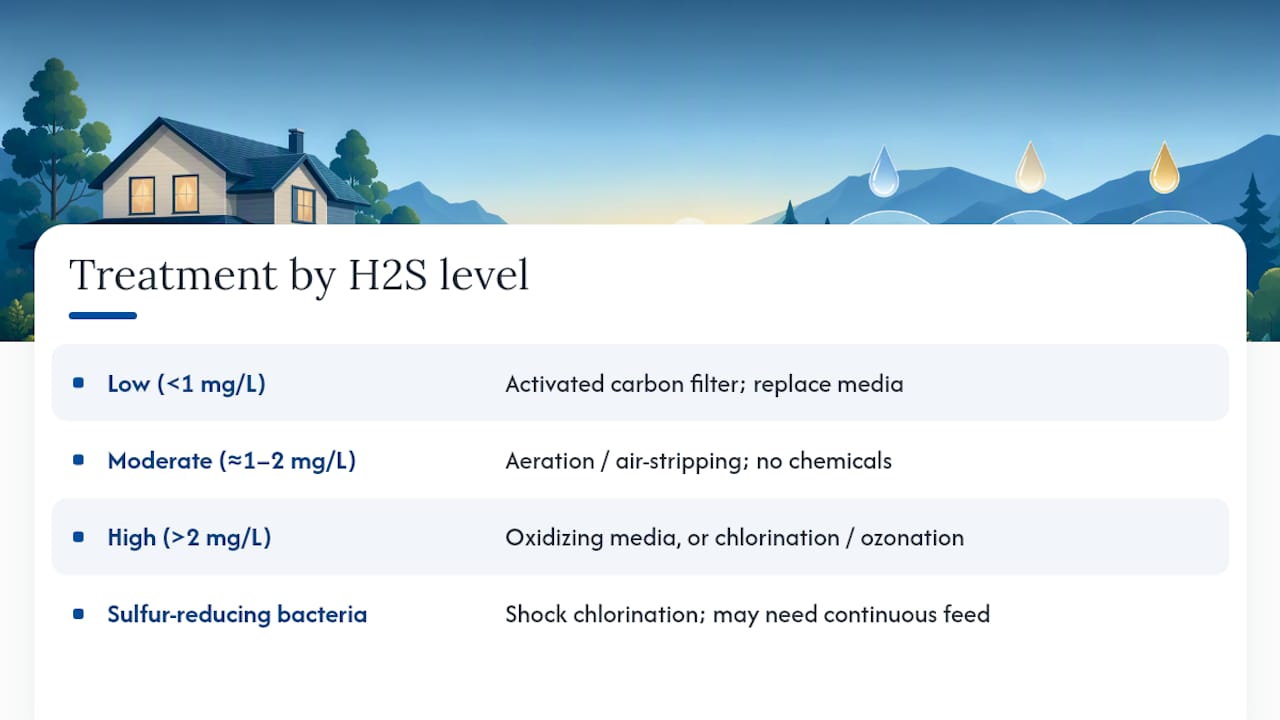
For low-level dissolved hydrogen sulfide (generally under 1 mg/L), activated carbon filtration is often enough. It’s inexpensive to install and requires no chemicals, but the carbon media has a limited capacity and needs regular replacement, more often in households with heavier sulfur levels than the filter was sized for.
For moderate concentrations (roughly 1 to 2 mg/L), aeration or air-stripping systems physically strip the dissolved gas out of the water before it reaches your fixtures. Penn State Extension notes aeration is typically not used much above 2 mg/L, since the process simply can’t keep pace with higher gas loads. The upside: no chlorine, no chemical feed pump, and lower ongoing cost than oxidizing systems.
For higher concentrations, oxidizing filters using manganese greensand media, continuous chlorination with a contact tank, or ozonation convert dissolved hydrogen sulfide into filterable sulfur particles. Some greensand systems handle up to roughly 2 to 3 mg/L depending on the media, beyond which continuous chlorination or ozonation becomes the more reliable option. These systems need backwash cycles, media replacement, and periodic chlorine feed calibration.
What the concentration tells you: Aeration handles roughly the bottom half of the typical residential H2S range without chemicals. Cross into the upper range, and you’re choosing between oxidizing media and chlorination, both of which demand more maintenance but handle a heavier load.
For sulfur-reducing bacteria, shock chlorination is the standard first move. A concentrated chlorine solution circulates through the well and plumbing system, sits for several hours, then gets flushed out. It often knocks the smell out fast, but success depends heavily on well construction and how deeply the bacteria have colonized the system. Recurrence is common enough that persistent cases usually need a continuous low-level chlorination setup rather than repeated one-time shocks.
Many real-world fixes combine steps: oxidation to convert the gas, filtration to remove the resulting particles, and a carbon polishing stage at the end to catch any residual odor or chlorine taste. Skipping the test and jumping straight to a random filter is the single most common way homeowners waste money on this problem.
Water Heater and Softener Fixes for Sulfur Odor
If your hot-vs-cold test pointed to the water heater, resist the urge to just yank out the magnesium anode rod. It’s a common DIY fix floating around online, and it’s a bad one.
Understand why the rod matters. The anode rod sacrifices itself to corrosion so your tank doesn’t. Magnesium rods can react with sulfate-reducing bacteria to produce hydrogen sulfide, but removing the rod entirely leaves the tank unprotected and can shorten its lifespan dramatically, plus void the manufacturer’s warranty.
Try flushing the tank first. Sediment buildup at the bottom of the tank can harbor bacteria and intensify odor. A full flush sometimes resolves mild cases without touching the anode at all.
Consider an aluminum or zinc anode rod instead. These alternatives provide similar corrosion protection with a lower tendency to react and produce sulfide gas. Swapping the rod type, rather than removing it, is the safer fix.
Sanitize the softener separately. If your bypass test implicated the softener, a chlorine-based sanitizing solution run through the resin bed and brine tank can clear bacterial buildup. Follow the manufacturer’s sanitizing procedure, or have a technician handle it if you’re not confident with the chemical handling.
Pro Tip: If the smell returns within a few weeks of flushing or sanitizing, that’s a sign the bacteria have colonized somewhere the DIY steps didn’t reach, usually deep in the well casing or a dead-leg section of pipe. That’s a call-a-professional moment, not a repeat-the-flush moment.
DIY works fine for flushing and softener sanitizing. Anode rod replacement, persistent heater odor, or anything involving well casing work is worth handing to a licensed plumber or well contractor.
Keeping Sulfur Smell From Coming Back
A one-time fix rarely stays fixed if you skip the maintenance behind it. Set an annual baseline water test as your default, and retest immediately any time an odor reappears, you complete plumbing repairs, or you notice a change in taste or clarity.
Routine tasks that keep systems working as designed:
Backwash oxidizing filters on the manufacturer’s recommended schedule, not just when the smell comes back
Replace activated carbon media before it reaches full capacity, since a saturated filter stops removing anything
Flush the water heater annually to limit sediment where bacteria can take hold
Recharge or resanitize softener resin per manufacturer guidance, especially in well-water households
Recurring slime, staining, or odor after a supposedly complete fix usually means a system component has failed or was undersized for your actual water chemistry. Neglected treatment systems don’t just stop working, they can let sulfur particles deposit inside your plumbing and accelerate corrosion, turning a filter replacement into a repiping job. Budget for the maintenance now; it’s cheaper than the alternative.
A Technician’s Take On Chasing Down Sulfur Odor
Most sulfur odor calls we get start with a homeowner who’s already bought something, a filter, a softener additive, sometimes a whole treatment system, before anyone tested the water. That’s backwards. The hot-versus-cold test costs nothing and takes ten minutes, and it eliminates entire categories of expensive guesswork before a wrench ever comes out.
On a first visit, a technician should run through the same checklist you can run yourself: hot vs cold, softener bypass, single fixture vs whole house, and a look for staining or slime. If bacteria seem likely, we lean toward shock chlorination first because it’s the least invasive option, but we tell homeowners upfront that recurrence is common enough that continuous treatment might be the real long-term answer. Equipment replacement is the last resort, not the first offer.
Safety matters more than people expect here. Chlorine handling in an enclosed mechanical room needs ventilation, and hydrogen sulfide itself gets more concentrated in tight spaces like crawlspaces or utility closets. Any plumbing technician worth hiring will ventilate before working, not after complaining about the smell.
— Dan Patino
Get a Straight Answer On Your Sulfur Smell
There are DIY test kits and internet forum fixes for sulfur odor, but most of them skip the step that actually matters: figuring out whether you’re dealing with bacteria, dissolved gas, or a failing water heater before you spend money treating the wrong problem. Texas Comfort Crew runs the same diagnostic flow public health departments recommend, hot versus cold, softener bypass, fixture-by-fixture, and gives you a transparent explanation of what the results mean before recommending anything.

A diagnostic visit includes a physical inspection of your water heater and softener, a recommendation on which lab tests actually apply to your situation, and a straightforward quote with repair-first pricing rather than a push toward full system replacement. If your water heater turns out to be the source, our plumbing team can handle anode rod replacement, tank flushing, or softener sanitation in the same visit. Homeowners who want ongoing protection against recurring odor and corrosion can add a maintenance membership with scheduled inspections built in. Ready to find out what’s actually causing the smell? Request a diagnostic visit and get a straight answer instead of a guess.
Where to Go for More Detail
For deeper reading on hydrogen sulfide chemistry and treatment thresholds, the Minnesota Department of Health’s well water guidance, Penn State Extension’s treatment breakdown, and the USGS explainer on earthy and rotten-egg odors cover the science in more depth than any single article can.
Sources
FAQ
Is It Safe to Drink Water That Smells Like Sulfur?
Hydrogen sulfide odor by itself is usually an aesthetic issue rather than a direct health hazard, but the smell doesn’t rule out other contaminants like bacteria or nitrate. Test your water through a state-certified lab before assuming it’s safe just because a filter removed the odor.
Should I Be Worried If I Smell Sulfur In My Water?
New or worsening sulfur odor is worth investigating, not ignoring, since it can signal anything from a harmless mineral shift in groundwater to bacterial contamination in your well or plumbing. Run the hot-versus-cold test first, then arrange lab testing if the smell persists or you have any health concerns.
How Long Does It Take to Get Sulfur Smell Out of Water?
Shock chlorination can clear bacterial odor within a day or two, though recurrence is common depending on well construction. Equipment-based fixes like aeration or oxidizing filters typically resolve dissolved-gas odor as soon as the system is installed and running correctly.
Is Showering In Sulfur-Smelling Water Safe?
Showering in water with a hydrogen sulfide odor is generally considered safe from a health standpoint, since the compound is typically an aesthetic rather than toxicological concern at household concentrations. If the smell is new, strong, or paired with visible staining or slime, get the water tested before treating it as routine.
Can Texas Comfort Crew Test My Water for Sulfur Smell?
Texas Comfort Crew performs on-site diagnostic visits to identify whether a water heater, softener, or plumbing issue is causing the odor, and recommends the appropriate lab tests for your situation. Pricing for diagnostic visits and follow-up plumbing work is available directly through Texas Comfort Crew.
Recommended
Comments