
4 Quick Checks Homeowners Can Do to Fix AC Blowing Warm Air
Warm air from your vents almost always traces back to one of four things: a clogged filter, a thermostat set to fan “On” instead of “Auto,” an outdoor unit that isn’t running, or a refrigerant problem. Start by setting the thermostat to Cool with the fan on Auto, then walk outside while the system is calling for cooling and check whether the condenser fan is spinning. If you smell burning or see sparking anywhere, shut the system off and call an emergency technician immediately.
TL;DR:
A dirty filter can restrict airflow by up to 50%, causing the evaporator coil to freeze and stop the system from cooling effectively.
A thermostat set to fan “On” instead of “Auto” can circulate warm air constantly, which is an easy fix to restore proper cooling.
Outdoor unit issues like debris, overgrown shrubs, or a non-spinning fan prevent heat exchange, often demanding a professional inspection or cleaning.
Refrigerant leaks or low levels require an EPA-certified technician to detect and seal, as they involve precise diagnostic tools and legal handling requirements.
Persistent frozen coils or repeated refreezing after thawing indicate a refrigerant leak or expansion valve failure, both needing specialized repair.
Table of Contents
Why Your AC Depends on Airflow, Refrigerant, and Electricity
Central air conditioning moves heat, it doesn’t create cold. Refrigerant absorbs heat from inside your home at the indoor evaporator coil, then carries it outside to the condenser coil, where the outdoor fan blows it away. When you understand that cycle, most warm-air problems make immediate sense.
Three things have to work together for cold air to reach your vents:
Airflow across both coils, so heat can actually transfer
Correct refrigerant charge, so the system has enough working fluid to absorb and release heat
Functioning electrical components (capacitors, contactors, breakers) that keep the compressor and fans running
Block the airflow with a dirty filter, and the evaporator coil gets too cold and ices over. Lose refrigerant to a leak, and the system can’t absorb heat efficiently no matter how well the fans spin. Either failure point produces the same symptom at your vents: air that should be cold but isn’t. The Department of Energy notes that routine checks and annual maintenance are what keep all three elements working in sync.
What’s Really Causing Your Air Conditioner to Blow Warm Air
Not every cause is equal in cost, urgency, or how much you can fix yourself. Here’s the likely list, roughly ordered from “you can handle this in ten minutes” to “hang up and call a licensed tech.”
Dirty or clogged air filter. A filter loaded with dust can restrict airflow by as much as 50%, starving the evaporator coil and eventually causing it to freeze. Pull the filter and hold it up to a light. If you can’t see light through it, replace it. This single fix resolves a huge share of warm-air complaints and takes about ten minutes.
Thermostat set to Fan “On” instead of “Auto.” When the fan runs continuously, it keeps circulating air through the ducts even between compressor cycles, and that air warms up fast. Switching the fan to Auto so it only runs while the compressor is actively cooling often solves the “warm air” complaint instantly.
Outdoor unit problems. Debris, overgrown shrubs, or a fence pressed too close to the condenser chokes off airflow. A dirty condenser coil can’t dump heat properly, and a fan that isn’t spinning means no heat exchange is happening at all.
Electrical failures. A tripped breaker, a failed run capacitor, or a worn contactor can stop the outdoor unit cold. Listen for a soft hum with no fan movement. That’s often a capacitor.
Low refrigerant or a leak. This always requires an EPA-certified technician, both by law and by necessity, since refrigerant work involves detecting and sealing leaks, not just topping off fluid.
Frozen evaporator coil. Ice on the indoor coil or refrigerant lines usually stems from restricted airflow or low charge. It needs to thaw before anyone can diagnose the real cause.
Blocked or closed vents and duct issues. Furniture over registers, closed vents in unused rooms, or collapsed flex duct all cut the airflow your system needs.
Compressor failure. Rare, and usually the last domino to fall after months of stress from the issues above.
Pro Tip: If a coil that just thawed refreezes within a few hours, that’s a strong sign of a refrigerant leak rather than a dirty filter. A frozen coil that keeps coming back is your cue to stop DIY-ing and call a pro.
Step-by-Step: How to Troubleshoot AC Blowing Warm Air
Work through these in order. Each step either fixes the problem or tells you exactly what to say when you call for service.
Check the thermostat first. Confirm it’s set to Cool, the setpoint is below room temperature, and the fan is on Auto, not On. Replace batteries if it’s a battery-powered model, and reset it per the manufacturer’s instructions if the display looks frozen or unresponsive.
Inspect the filter and vents. Replace a dirty filter. Walk the house and make sure supply vents are open and not blocked by rugs, curtains, or furniture.
Watch the outdoor unit during a cooling call. With the thermostat calling for cool, stand a safe distance away and look. Fan spinning and unit humming normally means the problem is likely indoors (airflow or refrigerant). Fan silent and unit dead quiet often points to a breaker or contactor. Fan silent but the unit is humming usually means a bad capacitor or seized fan motor.
Check your breaker panel. A tripped breaker for the outdoor unit is common after storms or power surges. Reset it once. If it trips again immediately, stop. A breaker that won’t hold is an electrical fault, not something to force.
If the fan doesn’t spin but you hear humming, stop there. That combination almost always means a failed capacitor or a seized fan motor, and a same-day repair is usually cheaper than letting the compressor overheat trying to compensate.
Still blowing warm after all of that? You’re likely looking at a refrigerant issue or a mechanical failure inside the compressor itself. Both require a licensed technician with gauges and proper tools.
If you find ice on the indoor coil or lines, turn the thermostat off entirely and set the fan to run alone for a few hours to melt it safely. Never scrape or chip at the ice. You risk puncturing the coil, turning a $150 repair into a $1,500 one. Homeowner checklists consistently rank filter, thermostat, outdoor unit, and vents as the four checks that resolve the majority of cooling complaints, and it’s worth working through them in that exact order before assuming the worst.
When Should You Call a Licensed HVAC Technician?
Some symptoms mean stop troubleshooting immediately and pick up the phone.
Burning smells, scorch marks, or visible arcing at the outdoor unit or electrical panel
A breaker that trips again the moment you reset it
The outdoor unit has power but stays completely silent, with no hum, no click, nothing
Signs of refrigerant leakage (oily residue near line connections, hissing sounds, persistent coil freezing)
The compressor short-cycles, turning on and off every few minutes
For anything less urgent, like a dirty coil or a suspected capacitor issue, same-day or next-day scheduling is reasonable. When the technician arrives, ask whether they’re EPA-certified for refrigerant handling, what specific diagnostic steps they’re running, and for a written quote before any repair begins.
Pro Tip: A trustworthy technician explains the diagnosis in plain language before recommending a fix. If someone jumps straight to “you need a new system” without walking you through what failed and why, get a second opinion.
Preventing Warm Air Problems Before They Start
Most warm-air calls are preventable with a handful of habits spread across the year.
Check your filter monthly and replace it every one to three months, depending on filter type and whether you have pets
Keep at least two feet of clearance around the outdoor unit and schedule a coil cleaning before peak summer heat
Leave the thermostat fan on Auto, and use scheduled setpoints instead of running the system continuously at aggressive temperatures
Book an annual professional tune-up that includes a refrigerant check and a duct inspection
ENERGY STAR’s maintenance checklist backs up nearly all of this, and for good reason. Small maintenance habits prevent the kind of coil freezing that eventually stresses a compressor into early failure. A regular HVAC maintenance plan with seasonal inspections built in takes the guesswork out of remembering when each task is due.
Checking and Calibrating the Thermostat Sensor
A miscalibrated thermostat can convince you your AC is broken when it isn’t. If the thermostat’s internal sensor reads a few degrees off from actual room temperature, it will cut the compressor cycle short, or run it too briefly to actually cool the space, leaving vents blowing air that feels warmer than it should.
Test it with a separate room thermometer placed near the thermostat, away from direct sunlight, vents, or lamps that could skew the reading. Let both sit for fifteen minutes, then compare. A gap of more than two or three degrees usually means the thermostat needs recalibration or replacement. Most digital models include a calibration offset setting in their menu, and the owner’s manual will walk you through it.

Placement matters more than people realize. A thermostat mounted on an exterior wall, near a window, or above a heat-generating appliance will consistently misread the room and cause short cycling that mimics a warm-air problem. If you’ve ruled out the filter, the outdoor unit, and the refrigerant charge, and the system still seems to underperform, the thermostat itself deserves a second look. Smart thermostats add another variable: a firmware glitch or a bad Wi-Fi connection can occasionally cause erratic cycling that looks exactly like a mechanical fault.
How Ductwork Leaks Quietly Sabotage Your Cooling
Even a perfectly healthy AC unit can blow warm air at the vents if the ductwork carrying that cold air is compromised. Leaky joints, crushed flex duct, or gaps where ducts pass through unconditioned attic space let cooled air escape before it ever reaches your living room.
The scale of the problem is bigger than most homeowners assume. Duct losses from leaks, poor insulation, or incorrect sizing can strip away 20 to 30 percent of a system’s effective cooling capacity. That means a system working perfectly at the equipment level can still leave rooms feeling warm simply because the air never makes it there at full strength.
Signs of duct trouble include uneven temperatures between rooms, a noticeable difference between air temperature at the vent closest to the unit versus the farthest one, and unexplained spikes in your cooling bills despite normal thermostat settings. Ducts running through a hot attic are especially vulnerable, since even small leaks let attic heat bleed into the airstream.
Sealing and insulating ductwork isn’t usually a weekend DIY project, especially in attics or crawlspaces where access is tight and mistakes are easy to make blind. A professional duct inspection, ideally paired with your annual tune-up, catches this before it becomes the reason a technically sound AC still can’t keep the house comfortable.
When the Expansion Valve Is the Real Culprit
The expansion valve, sometimes called a metering device, controls exactly how much refrigerant enters the evaporator coil. Too much refrigerant floods the coil and prevents proper heat absorption. Too little starves it, and you get the same warm-air symptom from the opposite direction.
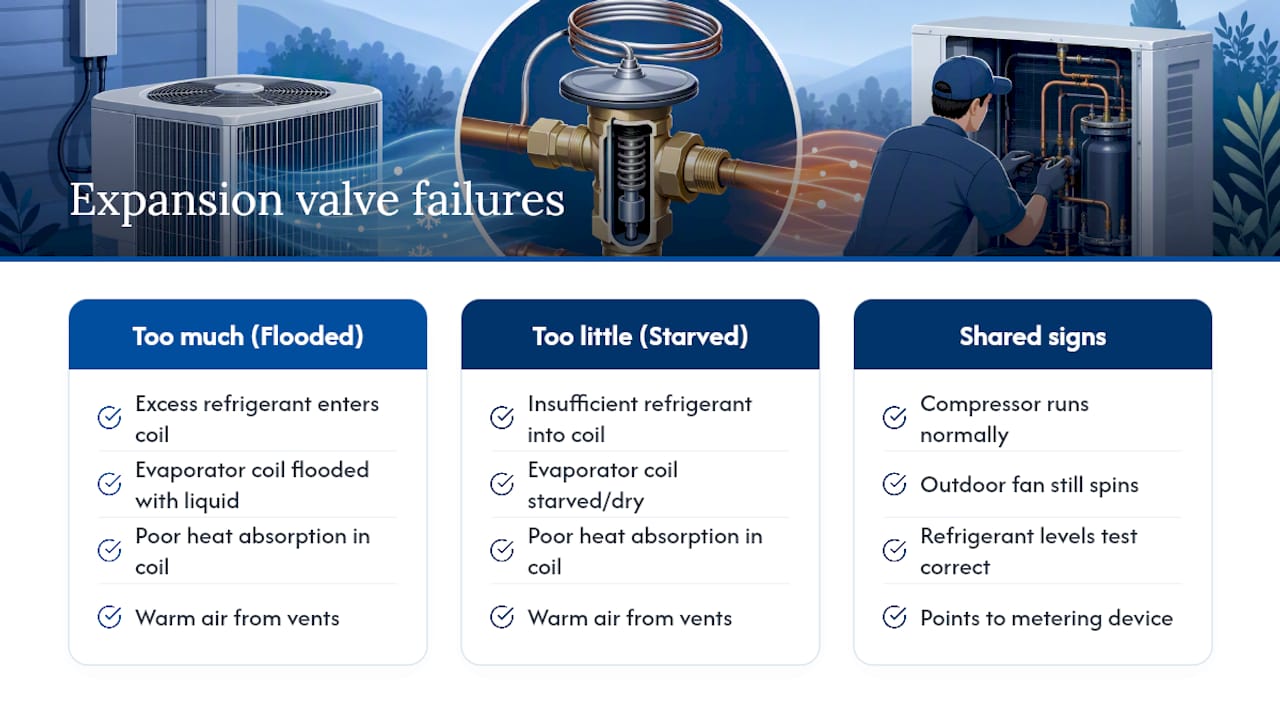
A stuck or failing expansion valve produces a confusing pattern: the compressor runs, the outdoor fan spins, refrigerant levels test correctly, and yet the air at your vents still comes out warm. That’s usually the tell that points a technician toward the metering device rather than a simple leak. Contamination, moisture inside the refrigerant lines, or a wax element that’s degraded over time are common culprits behind valve failure.
This is squarely in EPA-certified-technician territory. Diagnosing a bad expansion valve requires pressure and temperature readings taken at specific points in the refrigerant circuit, tools and training well beyond what any homeowner checklist covers. If you’ve ruled out the filter, thermostat, outdoor unit, breakers, and obvious refrigerant leaks, and the system is still underperforming, mention the possibility of an expansion valve issue when you call for service. It helps the technician arrive prepared with the right diagnostic tools instead of starting from scratch.
What Separates a Trustworthy AC Repair Visit From a Sales Pitch
A good technician diagnoses before they prescribe. That means checking the filter, the thermostat, the outdoor unit, and refrigerant pressures, and explaining what they find in plain terms before recommending anything. Ask whether they’re EPA-certified, what specific tests they ran, and for a written estimate before work begins.
Repair-first thinking matters here. A capacitor or a duct leak shouldn’t turn into a system replacement conversation unless the numbers genuinely support it. Clear communication and a walk-through of the actual failure, not just a quote, is what separates an honest visit from a sales pitch.
— Dan Patino
Why Texas Comfort Crew Fits This Exact Problem
If you’ve worked through the filter, thermostat, and outdoor unit checks and your air conditioner is still blowing warm air, you’re at the point where guessing costs more than it saves. A good service provider evaluates the whole system, refrigerant charge, electrical components, ductwork, and the expansion valve before recommending a fix, and repairs rather than replaces whenever the equipment can genuinely be saved.

That matters because a capacitor swap or a duct seal is a fraction of the cost of a new system, and you shouldn’t be sold a replacement for a problem a repair can solve. Every visit comes with a clear explanation of what failed, why, and a written estimate before anyone touches your equipment. Homeowners across the Greater San Antonio area, including those in the Helotes and New Braunfels areas, rely on this same repair-first approach for both HVAC and plumbing work. If your ductwork runs through an older attic space, pairing an AC diagnosis with a look at your home’s interior insulation and energy efficiency can catch losses a filter change alone won’t fix.
Check your address against the full service area and schedule a diagnostic visit before the next heat wave turns a small fix into an emergency call.
Sources
FAQ
How Do I Fix My AC Blowing Warm Air?
Start with the thermostat (Cool mode, fan on Auto) and the filter, then check whether the outdoor unit’s fan is spinning during a cooling call. If the filter and thermostat check out and the outdoor unit still isn’t running properly, the issue is likely electrical or refrigerant related and needs a licensed technician.
Should I Turn Off the AC If It’s Blowing Warm Air?
Turn the system off if you notice burning smells, electrical arcing, or a coil that’s visibly frozen. Running a struggling compressor or a frozen coil longer than necessary risks turning a repairable issue into a much more expensive one.
How Do I Reset My AC When It’s Not Blowing Cold Air?
Turn the thermostat off, flip the outdoor unit’s breaker off for about sixty seconds, then turn both back on and set the fan to Auto. If the system still doesn’t cool after a reset, the problem is mechanical or electrical rather than a simple glitch.
Is AC Blowing Hot Air an Emergency?
It’s not automatically an emergency, but certain signs are: burning smells, visible electrical damage, or an outdoor unit with power that produces no sound or movement at all. Those warrant an emergency call rather than waiting for standard scheduling.
Recommended