
15–22 gpg Hard Water Is Aging San Antonio Homes, and How to Stop It
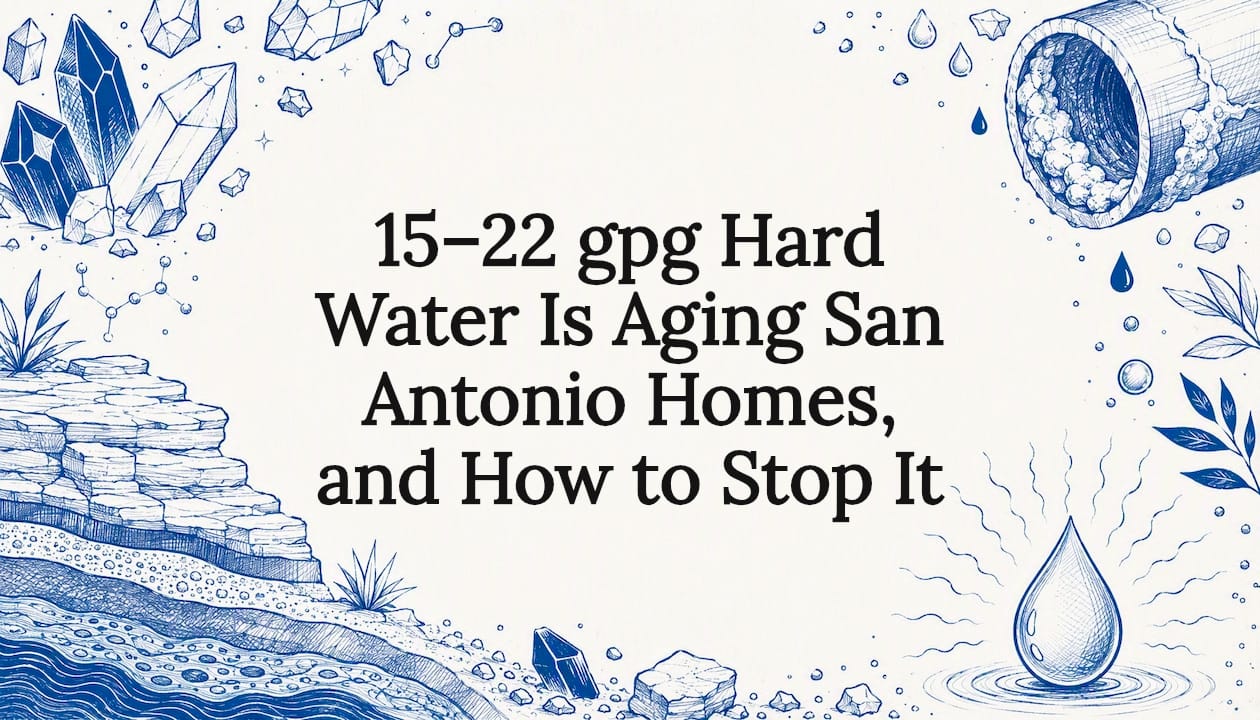
San Antonio’s tap water runs 15 to 22 grains per gallon, roughly 300 parts per million, placing it firmly in the “very hard” category. That’s not a health concern, according to the utility itself, but it’s a mechanical one that shows up as scale, shortened appliance life, and higher soap use. If you notice white crust on faucets or your water heater is aging faster than expected, testing your water and evaluating treatment options is recommended.
TL;DR:
San Antonio’s water consistently measures between 15 and 22 grains per gallon, making it not only very hard but also demanding specific treatment solutions.
Ion-exchange water softeners are the most effective method for high-grade hardness, fully eliminating minerals and preventing scale buildup inside appliances.
Households should test their actual water hardness to size the softener correctly; a simple soap test and water sample sit test can provide quick assessments.
Hard water accelerates appliance wear, especially in water heaters, which often produce noises and fail earlier due to mineral scale.
Softening systems require ongoing maintenance, such as salt or potassium chloride replenishment, and should be installed or checked by licensed professionals to ensure proper sizing and function.
Table of Contents
How Hard Is San Antonio’s Water, Exactly?
The San Antonio Water System puts typical hardness between 15 and 20 grains per gallon (gpg), and third-party trackers estimate a citywide weighted average closer to 17.5 gpg, or about 300 parts per million. Either way you slice it, you’re well past the threshold most water-quality scales used to define “hard.”
Here’s how the standard classification breaks down, so you can read a test strip or a utility report without guessing:
Classification | Grains per gallon (gpg) | Parts per million (ppm) |
Soft | Less than 1 | Less than 17 |
Slightly hard | 1 to 3.5 | 17 to 60 |
Moderately hard | 3.5 to 7 | 60 to 120 |
Hard | 7 to 10.5 | 120 to 180 |
Very hard | Over 10.5 | Over 180 |
San Antonio’s hardness level is significantly above the “very hard” threshold. Your exact number can shift block by block, since SAWS blends water from several sources, so a reading of 14 gpg in one neighborhood and 21 gpg a few miles away is normal, not a sign something’s wrong.
Why Is San Antonio’s Water So Hard?
Blame the ground beneath the city. Most of San Antonio’s supply comes from the Edwards Aquifer, a massive underground reservoir formed in porous limestone, and as rainwater filters down through that rock it dissolves calcium and magnesium along the way, according to local reporting on the aquifer’s role. Those dissolved minerals are what make water “hard.”
SAWS also draws from the Carrizo, Trinity, and Wilcox aquifers, and the mineral content varies slightly between them, which is part of why hardness readings differ across town, per the utility’s own water quality report. None of this is a plumbing defect or a treatment failure upstream. It’s geology, and it’s been the same story since before the city existed. A notable household issue occurs with heat: minerals in hard water tend to form scale inside water heaters when heated.
What Hard Water Actually Does to Your Home
The effects sneak up on you. Nobody notices 17 gpg directly. What you notice is the downstream damage.
White, chalky buildup on faucets, showerheads, and glass shower doors
A water heater that takes longer to heat and makes popping or rumbling noises as sediment builds
Coffee makers, dishwashers, and washing machines wearing out faster than the warranty suggests
Spots on dishes and glassware straight out of the dishwasher
Laundry that feels stiff or scratchy, plus needing more detergent to get the same clean
Skin that feels dry after a shower and hair that feels coated, both cosmetic rather than medical
The USGS notes that scale buildup on heating elements reduces efficiency and can shorten the working life of the appliance. That’s the real cost of hard water: not a health bill, but a repair and replacement bill. A water heater that should run 10 to 12 years can fail closer to 6 or 7 when scale insulates the heating element and forces it to work harder for the same result.
Pro Tip: If your water heater is making a popping sound like a coffee percolator, that’s usually mineral sediment trapped at the bottom of the tank, not a mechanical failure. It’s often an early scale warning, not an emergency.
How to Test Your Home’s Water Hardness
You don’t need a lab to get a rough answer. Start simple, then get more precise if the numbers matter to a purchase decision.
Try the soap-lather test. Shake a small amount of liquid soap with tap water in a clear bottle. Hard water resists forming suds and instead produces a cloudy, film-like layer.
Rule out the wrong culprit first. Cloudy or milky water straight from the tap is usually trapped air, not hardness. SAWS recommends letting a glass sit for a minute: if it clears from the bottom up, that’s air, not mineral content.
Use a test strip or digital meter. Drugstore and hardware store strips give you a gpg or ppm reading in about 15 seconds, though they’re a ballpark, not a lab-grade number.
Check SAWS’ published data. The utility’s annual water quality report lists source aquifers and hardness ranges for the system.
Order a lab test or in-home pro assessment if you’re about to invest in a softener and want an exact grain count for sizing.
Real Fixes for San Antonio’s Hard Water
Treatment options aren’t one-size-fits-all, and picking the wrong one for 15 to 22 gpg water wastes money either through under-treatment or overkill.
Ion-exchange water softeners remain the most reliable fix at San Antonio’s hardness levels. They swap calcium and magnesium for sodium or potassium ions, and they need periodic regeneration with salt (or potassium chloride) to keep working.
Salt-free conditioners don’t remove hardness minerals. They alter their structure so the minerals are less likely to stick to pipes and fixtures as visible scale. They’re a reasonable middle ground for renters or homes where sodium in wastewater is a concern, but they won’t stop the “no lather” feeling of hard water.
Point-of-use reverse osmosis systems, usually installed under the kitchen sink, tackle drinking and cooking water specifically. They pair well alongside a whole-house softener rather than replacing one, since RO units aren’t built to treat your entire home’s flow.
Low-cost habits buy you time between bigger decisions: keep your water heater thermostat around 120°F, since lower temperatures slow scale formation, and descale faucets and showerheads periodically with a white vinegar soak.
Pro Tip: A vinegar soak on a scaled showerhead (unscrew it, submerge it in undiluted white vinegar for an hour) restores most of the water flow you thought you’d lost to old plumbing. It’s often the softener, not the pipe.
What a Softening System Actually Costs to Own
Budgeting for hard water treatment means accounting for both the install and the years after it. A whole-house ion-exchange softener sized correctly for San Antonio’s hardness typically represents a mid-range home improvement investment, with ongoing costs for salt, occasional resin bed service, and periodic valve maintenance. A point-of-use RO system for drinking water is a smaller upfront cost, with filter cartridge changes as the main recurring expense.
Sizing matters more than most homeowners realize. The basic formula: multiply your household’s daily water use in gallons by your hardness in grains per gallon, and that tells you the grain capacity your softener needs to handle between regeneration cycles. A family of four using around 300 gallons a day at 18 gpg needs a system rated well above the entry-level residential units sold at big-box stores, which is exactly where a lot of DIY installs fall short and start regenerating too often.
When to Call a Local Plumbing Pro
Some signs mean it’s time to stop guessing and get a professional look. Visible scale inside a water heater tank, appliances failing well before their expected lifespan, or a noticeable drop in water pressure across multiple fixtures all point past a DIY fix.
A proper diagnostic visit should include an actual hardness measurement, not just an assumption based on your zip code, plus a look at your existing plumbing and correct system sizing for your household’s water use. Before hiring anyone, ask about warranty terms, what ongoing maintenance costs, and get the scope in writing.
Texas Comfort Crew builds its assessments around this same standard: measure first, explain what the numbers mean, and recommend repair over replacement whenever that’s genuinely the better call for the homeowner. That’s also where a membership plan earns its keep, since preventative inspections catch scale buildup before it becomes a failed water heater.
Do You Need a Permit for a Water Softener in San Antonio?
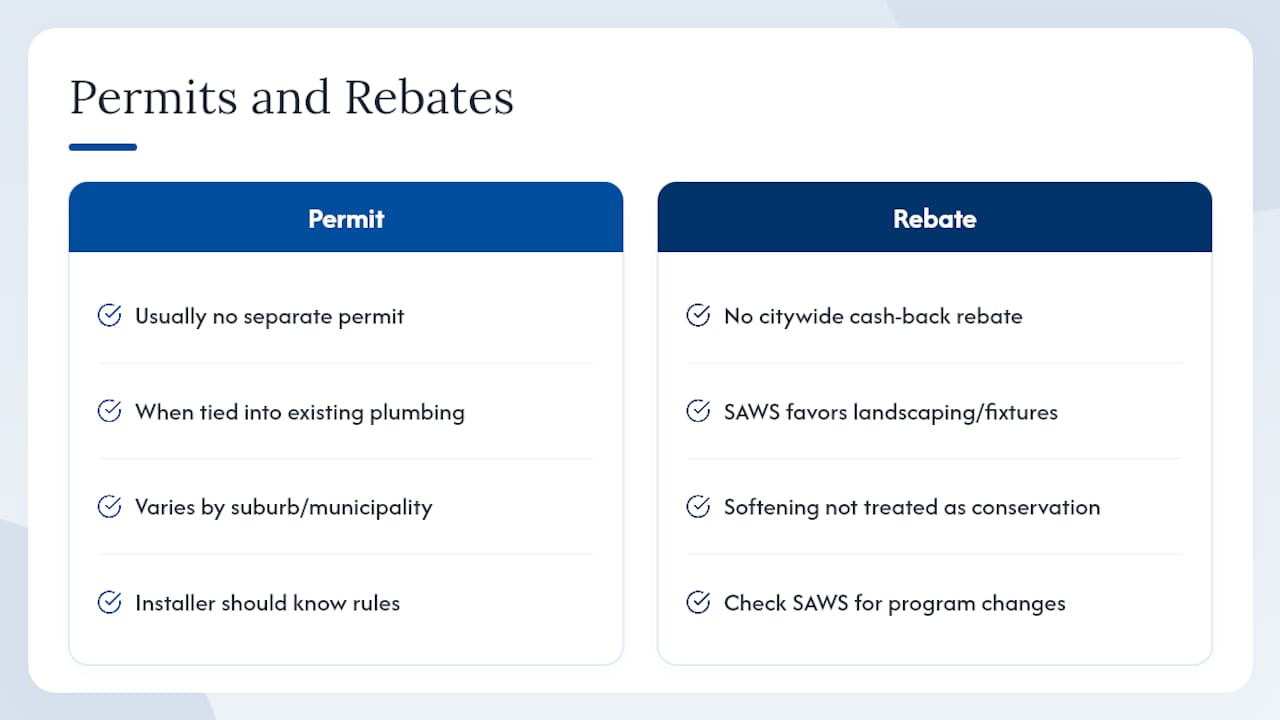
Most residential water softener installations in San Antonio don’t require a separate permit if a licensed plumber ties the system into existing plumbing without altering the home’s main water line configuration. That said, permit requirements can shift depending on your specific municipality within the greater San Antonio area, and some suburbs handle this differently than the city itself. Any reputable installer should know your local requirements without you having to ask twice.
On the rebate side, San Antonio doesn’t currently run a citywide cash-back program specifically for water softener installation the way some cities offer rebates for low-flow toilets or irrigation upgrades. SAWS has historically focused conservation incentives on landscaping, irrigation efficiency, and fixture replacement rather than water softening equipment, since softening is considered an aesthetic and equipment-protection upgrade rather than a conservation measure.
That distinction matters for your budget. Don’t go into a softener purchase expecting a utility rebate to offset the cost. Factor the full installed price into your decision, and treat any manufacturer or installer promotional discount as the only markdown you’re likely to see. If regulations or incentive programs do change, they’ll typically show up first in SAWS’ own customer communications or the city’s utility billing inserts, so that’s the place to check before assuming a rebate exists.
Which Water Softening Option Actually Fits San Antonio’s Water?
San Antonio’s hardness range of 15 to 22 gpg is high enough that not every softening technology on the market performs the same way here as it might in a moderately hard water market. The comparison that actually matters isn’t brand versus brand. It’s technology versus your hardness number.
Ion-exchange systems are engineered specifically to handle high-grain water and remain the standard recommendation once you’re consistently above 10 gpg, which San Antonio is by a wide margin. They fully remove hardness minerals rather than just altering them, which means they’re the only category that eliminates scale formation entirely rather than reducing it.
Salt-free conditioners work by changing mineral structure so it doesn’t adhere to surfaces, and they perform reasonably in moderately hard water. At San Antonio’s mineral concentration, though, many homeowners find the scale-prevention effect less complete than what a true softener delivers, particularly on water heater elements where heat accelerates mineral crystallization. They’re a fit for households prioritizing low maintenance and no salt over total scale elimination.
Reverse osmosis solves a different problem entirely; it’s a drinking-water purifier, not a whole-house hardness fix, and treating your home’s full water supply with RO alone isn’t practical or cost-effective at this scale. The realistic pairing for most San Antonio homes: a whole-house ion-exchange softener for the plumbing and appliances, with a point-of-use RO system under the kitchen sink if you want the cleanest possible drinking and cooking water on top of that.
Environmental Impact and Smarter Water Use With a Softener
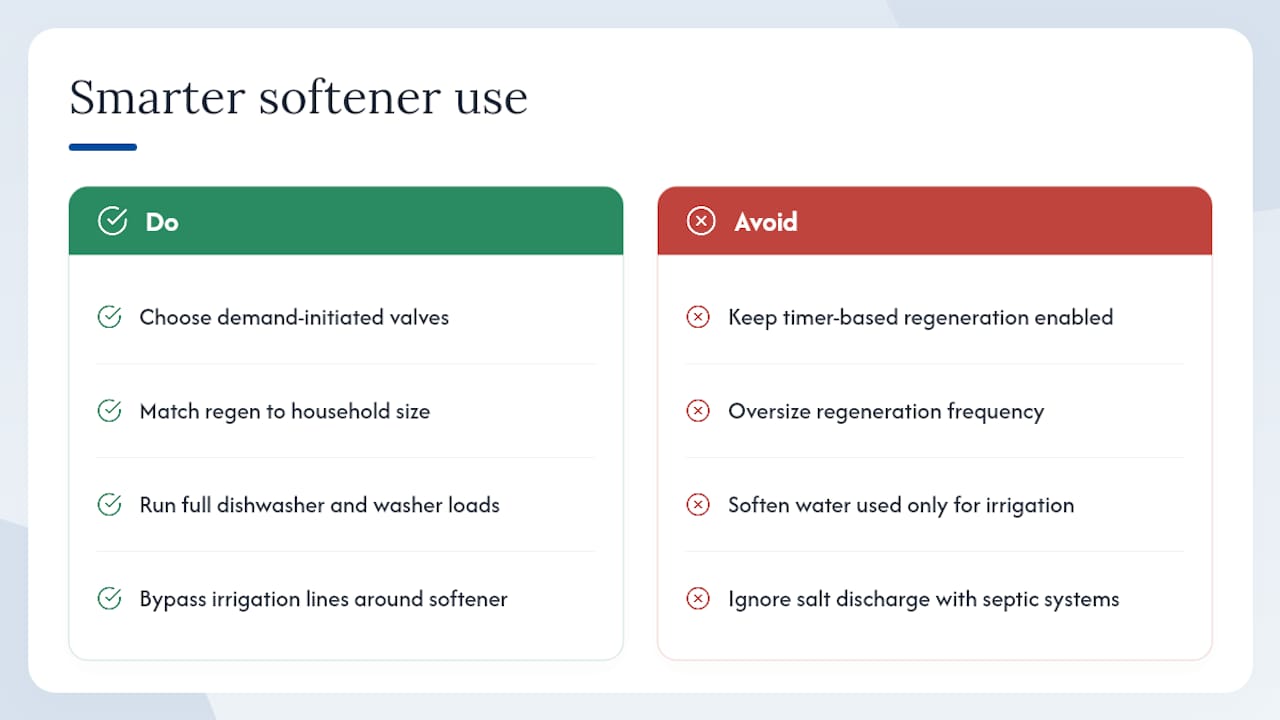
Softeners use water and salt to regenerate, and that’s a legitimate tradeoff worth understanding before you install one. Older, less efficient softener valves regenerate on a fixed timer regardless of actual usage, wasting water and salt on cycles the household didn’t need. Modern demand-initiated regeneration valves track actual water use and only regenerate when the resin bed is genuinely depleted, cutting both water and salt consumption significantly compared to timer-based models.
Salt discharge from softener regeneration is also worth a second thought if your home is on a septic system, since higher sodium content in wastewater can affect septic bacteria over time; potassium chloride is a common substitute for households in that situation, though it costs more per bag than standard sodium chloride pellets.
A few habits stretch your system’s efficiency further; to learn how local climate conditions can also affect your home’s materials, see how San Antonio’s heat and humidity affect interior doors. Match your softener’s regeneration cycle to your actual household size rather than a generic factory setting, since oversized regeneration frequency is one of the most common waste points homeowners never think to check. Running full loads in the dishwasher and washing machine, rather than partial ones, reduces the total volume of softened water your system needs to produce. And if outdoor irrigation is on the same line as your softened water, routing sprinkler and hose bib lines around the softener (a bypass loop) saves you from softening water that’s just going into the lawn anyway, cutting salt and water use with zero downside for your grass.
A Local Pro’s Quick Take
Most calls we see follow the same pattern: scale ignored for years, then a water heater fails early or a dishwasher quits well before its time. Test first. Pick the least invasive fix that actually solves the problem you measured, not the one a salesperson pushes hardest. Regular maintenance is what keeps a softener, and everything downstream of it, running the way it should for years.
— Dan Patino
Get a Straight Answer on Your Water and Plumbing
Texas Comfort Crew is the alternative to guesswork and upsell tactics for hard water problems in the Greater San Antonio area: a real diagnostic visit, an honest read on whether you need a softener or just a repair, and a written plan before any work starts.
Our plumbing team handles water heater scale damage, softener installation, fixture repairs, and diagnostics that reveal what’s happening in your home’s pipes. We prioritize fixing what can be fixed over selling a full system replacement, and our membership plan keeps preventative inspections on schedule so scale never gets the chance to take down a water heater early. If you’re seeing buildup, dealing with appliance failures, or just want to know your actual hardness number, check our plumbing services page and confirm we’re in your area on our service area map, then schedule an assessment.
Where This Information Comes From
Local hardness figures and treatment guidance draw on the SAWS Water Quality FAQ and annual Water Quality Report, plus USGS and Water Quality Association technical guidance.
Sources
FAQ
Does San Antonio Have Very Hard Water?
Yes. San Antonio’s water measures 15 to 22 grains per gallon, roughly 300 parts per million, which puts it solidly in the “very hard” classification used by water treatment professionals.
Which State Has the Worst Hard Water?
Hardness varies widely across the United States and depends heavily on local geology, but states with extensive limestone and dolomite formations, including much of Texas, Arizona, and the Midwest, tend to show the highest readings nationwide.
What City Has the Hardest Water in Texas?
Multiple Texas cities sitting over limestone aquifers report very hard water, and San Antonio is consistently among the hardest in the state due to its dependence on the Edwards Aquifer.
Is Texas a Hard Water State?
Most of Texas deals with moderately hard to very hard water because so much of the state sits over limestone and dolomite bedrock, and San Antonio’s 15 to 22 gpg range sits toward the harder end of that spectrum.
Will a Water Softener Fix Low Water Pressure Caused by Scale?
A softener stops new scale from forming, but it won’t remove buildup already lodged inside old pipes. If you’re seeing reduced flow, that usually calls for a plumbing inspection alongside softener installation.
Recommended
Comments